
HVAC FAQs for Des Plaines Homeowners
Straightforward answers about furnace repair, air-conditioning service, heat pumps, maintenance, replacement, indoor air quality, thermostats, parts and warranties from Any Season Heating & Cooling.
Find the HVAC Answer You Need
These answers provide useful general guidance. Because equipment, homes and symptoms differ, an on-site diagnosis may still be needed before repair or replacement.
When Should You Stop the HVAC System and Call?
Turn the equipment off and request professional help if you smell gas, see smoke or sparks, hear severe mechanical noise, notice repeated breaker trips, find significant water near electrical components, or suspect unsafe combustion or venting.
For a gas odor, leave the area and contact the gas utility or emergency services from a safe location. Do not operate switches or attempt equipment repairs.
Need active service?
Visit furnace repair, AC repair or heat-pump repair.
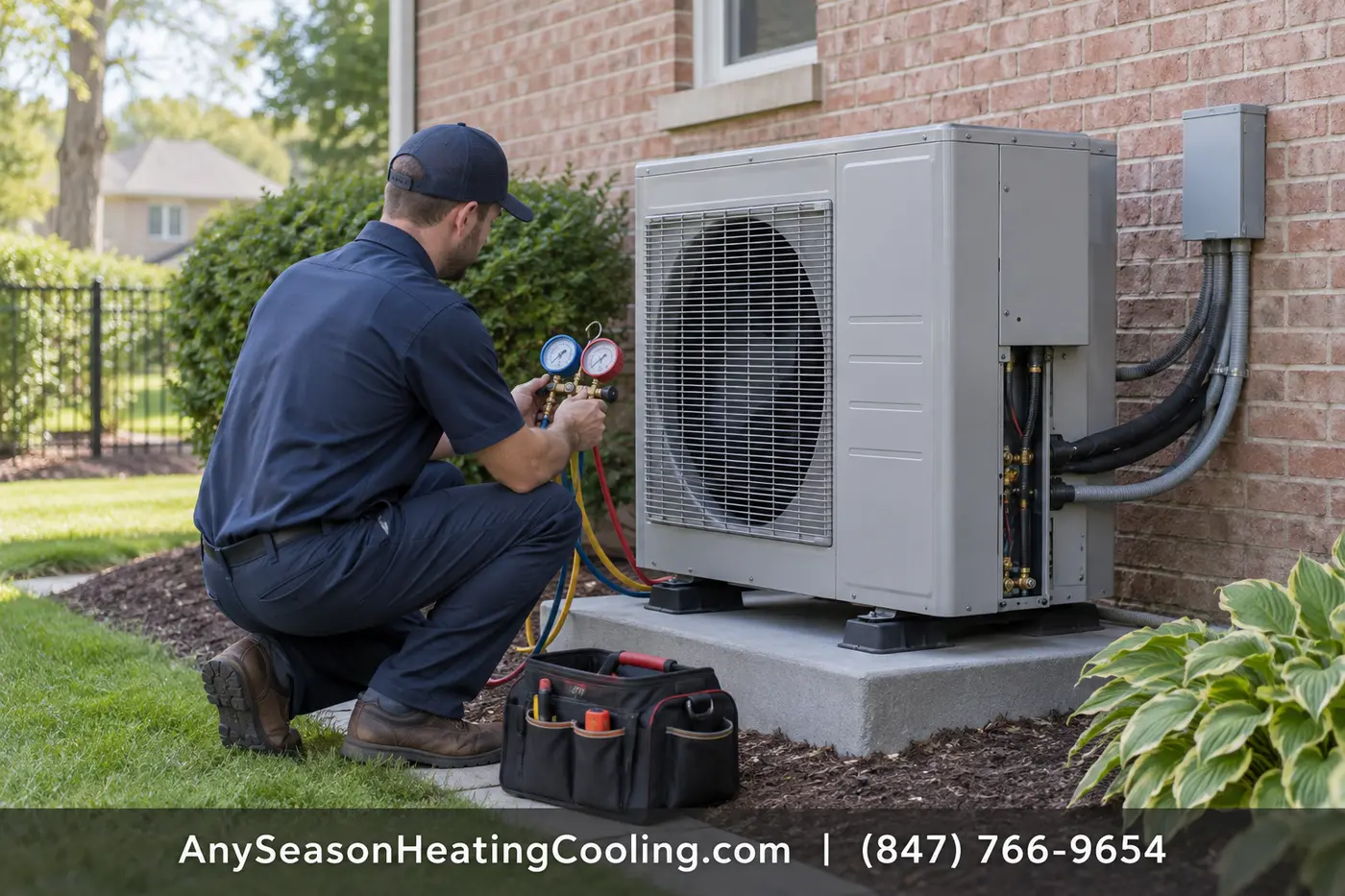
General HVAC Service FAQs
What areas does Any Season Heating & Cooling serve?
We are based in Des Plaines and serve homeowners throughout nearby northwest suburban communities, including Mount Prospect, Park Ridge, Niles, Glenview, Arlington Heights, Prospect Heights, Rosemont, Elk Grove Village, Buffalo Grove, Palatine, Norridge, Wheeling, Northbrook, Schaumburg and nearby areas. Call to confirm availability for your address.
Is 24/7 emergency HVAC service available?
We offer 24/7 residential HVAC assistance for urgent heating and cooling problems, subject to technician availability, weather and service conditions. Call 847-766-9654 for the earliest available service option.
How do I schedule HVAC service or request an estimate?
Call or text 847-766-9654, or use our online estimate form. For an active furnace or air-conditioning breakdown, calling is usually the fastest way to discuss symptoms and scheduling.
What HVAC brands do you repair?
We service major residential brands including Trane, American Standard, Carrier, Bryant, Lennox, Goodman, Amana, Daikin, Rheem, Ruud, York, Guardian and many related equipment families. Parts and procedures are always verified by model and serial number.
How do I decide whether to repair or replace my HVAC system?
Consider the equipment’s age and condition, repair history, comfort performance, energy use, parts availability and the cost of the present repair. An isolated failure on dependable equipment often supports repair; repeated failures or a major component problem may justify comparing replacement options.
What information should I provide before the technician arrives?
If possible, provide the equipment brand, model number, approximate age, symptoms, error code, when the problem started and any recent work. Photos can help identify the equipment, but an on-site diagnosis is usually required before a repair recommendation.
Furnace & Heating FAQs
Why is my furnace running but not heating the house?
Possible causes include an incorrect thermostat setting, ignition or flame-sensing problems, restricted airflow, a failed control, a gas-supply issue, a safety-limit condition or another component fault. Turn the system off if you smell gas or see unsafe operation, and arrange professional diagnosis.
Why is my furnace blowing cold air?
A furnace may blow cool air during startup or after the burners shut down, but continuous cold airflow can indicate an ignition failure, thermostat problem, overheating shutdown, control fault or airflow restriction. Check the thermostat and filter, then call if heating does not resume.
What causes a furnace to start and stop repeatedly?
Short cycling can result from restricted airflow, overheating, thermostat placement, flame-sensing issues, pressure-switch problems, equipment sizing or control faults. Repeated cycling should be diagnosed because it can increase wear and reduce comfort.
Is a burning smell from the furnace normal?
A light dusty smell may occur briefly when heating starts after a long shutdown. A strong electrical, plastic, smoky or persistent odor is not normal. Turn the equipment off and request service, especially if you see smoke or the breaker trips.
How often should a furnace receive maintenance?
Annual furnace maintenance before or during the heating season is a practical schedule for most homes. Service typically includes inspection, operating checks, airflow and temperature measurements, cleaning of accessible components and verification of safety controls.
What are common signs that a furnace may need replacement?
Frequent repairs, uneven heating, excessive noise, visible deterioration, rising energy use, an unavailable major part or a failed heat exchanger can make replacement worth comparing. Age alone does not determine the answer; condition and repair economics matter.
Can you repair gas and electric furnaces?
Yes. We diagnose residential gas and electric furnaces. The testing process differs by equipment type, but both require verification of controls, airflow, electrical operation and applicable safety devices.
Air Conditioning FAQs
Why is my air conditioner running but not cooling?
Common possibilities include a dirty filter, restricted airflow, a failed capacitor or motor, thermostat issues, dirty coils, low refrigerant caused by a leak, compressor problems or incorrect system operation. Testing is needed before adding refrigerant or replacing parts.
Why is ice forming on my AC refrigerant line or indoor coil?
Freezing can be caused by low airflow, a dirty filter, a blower problem, a blocked coil, low refrigerant or another system fault. Turn cooling off to allow the ice to melt and avoid running the system while frozen.
Why does my AC run continuously on hot days?
Long cycles can be normal during extreme weather, but continuous operation may also indicate dirty coils, airflow restrictions, thermostat settings, duct losses, low refrigerant, equipment condition or insufficient capacity. Comfort and temperature performance should be measured.
Why is water leaking around my furnace or air handler during cooling season?
Cooling creates condensation that should drain safely. Water may appear because of a blocked drain, damaged pan, disconnected line, frozen coil or condensate-pump failure. Shut the system off if water could damage equipment, ceilings or flooring.
How often should central air conditioning be maintained?
Annual AC maintenance before or during the cooling season is appropriate for most systems. Service should include electrical checks, coil and drain inspection, airflow evaluation and temperature-performance measurements.
When should I consider replacing my air conditioner?
Compare replacement when repair costs are high, the system has repeated failures, uses an obsolete refrigerant, cannot maintain comfort, has a major compressor or coil problem, or no longer makes economic sense for its condition.
Should I cover my outdoor AC condenser during winter?
A full airtight cover can trap moisture and invite pests. Outdoor units are designed for weather exposure. If protection from falling debris is needed, use an appropriate top cover without blocking ventilation, and remove it before operation.
Heat Pumps & Efficiency FAQs
How does a heat pump heat and cool a home?
A heat pump moves heat rather than creating all heating through combustion. In cooling mode it transfers heat outdoors; in heating mode it reverses the refrigeration cycle and draws heat from outdoor air. Some systems use auxiliary heat during colder conditions.
Can a heat pump work during an Illinois winter?
Modern heat pumps can provide useful heating in cold weather, but performance depends on the equipment, system design, outdoor temperature, home heat loss and backup-heat strategy. Proper sizing and installation are essential.
Why does my heat pump switch to auxiliary or emergency heat?
Auxiliary heat may operate during very cold conditions, defrost cycles or when the thermostat calls for a large temperature increase. Unexpected or continuous auxiliary operation can indicate thermostat settings, outdoor-unit problems or insufficient heat-pump output.
Why does the outdoor heat-pump unit sometimes produce steam?
During cold-weather defrost, the unit temporarily warms the outdoor coil to melt frost. Water vapor or steam can appear and is often normal. Heavy ice that never clears, unusual noise or loss of heat should be inspected.
How often does a heat pump need maintenance?
Because a heat pump may operate for both heating and cooling, it should be checked at least annually; many homeowners schedule service twice a year. Filters and outdoor-unit clearance also need regular attention.
What do SEER2, EER2 and HSPF2 mean?
These ratings describe standardized cooling or heating efficiency. Higher ratings can indicate greater efficiency under test conditions, but actual energy use also depends on sizing, ductwork, installation, thermostat settings, weather and home construction.
Indoor Air Quality & Controls FAQs
Will an air purifier remove every contaminant from my home?
No single device removes every particle, gas, odor or biological contaminant. The right solution depends on the concern and may involve filtration, source control, ventilation, humidity management or a compatible whole-home air purifier.
What does a whole-home humidifier do?
A whole-home humidifier adds controlled moisture to heated air during dry conditions. Proper humidity can improve comfort and reduce excessive dryness, but the equipment must be sized, maintained and controlled to avoid excess moisture.
Do HVAC UV lights clean all the air in a house?
UV-C equipment is designed to expose specific surfaces or moving air inside compatible HVAC systems. It can support an indoor-air-quality strategy, but it does not replace filtration, cleaning, humidity control or proper ventilation.
How often should I replace my HVAC filter?
Replacement frequency depends on filter type, system use, pets, construction dust, indoor-air concerns and manufacturer guidance. Inspect the filter monthly at first, then establish a schedule based on how quickly it becomes loaded.
Why is my home dusty even when I change the filter?
Dust may come from outdoor air, open doors, fabrics, pets, renovation work, duct leakage, return-air gaps or a filter that does not fit correctly. The solution depends on the source rather than simply choosing the highest-rated filter.
Can a smart thermostat work with my HVAC system?
Many systems support smart thermostats, but compatibility depends on equipment type, wiring, staging, communicating controls, heat-pump configuration and available power. Compatibility should be verified before installation.
Why are some rooms hotter or colder than others?
Uneven comfort can result from airflow imbalance, closed or blocked registers, duct leakage, insulation differences, sun exposure, equipment operation or thermostat location. Airflow and temperature measurements help identify the cause.
Installation, Parts & Warranty FAQs
How long does furnace or AC replacement take?
Many straightforward residential replacements can be completed in one working day, but timing depends on equipment configuration, duct changes, electrical work, permits, access and unforeseen conditions. The project scope should be reviewed before scheduling.
Why is proper HVAC sizing important?
Oversized equipment may cycle too quickly, create temperature swings and provide poor humidity control. Undersized equipment may struggle during peak conditions. Sizing should consider the home’s heat gain and heat loss rather than simply matching the old model.
Can parts from sister HVAC brands be used interchangeably?
Not automatically. Related brands may share corporate ownership or some components, but compatibility must be confirmed using the exact model, serial number, part number, electrical rating and manufacturer documentation.
Does a manufacturer warranty cover labor and every repair cost?
Warranty coverage varies by brand, registration, equipment, component and installation date. A parts warranty often does not cover diagnostic labor, installation labor, refrigerant, shipping or unrelated components. Coverage should be verified before work.
Why do you need the model and serial number before ordering a part?
Those numbers identify the equipment design, production series, capacity and approved components. Visual similarity is not enough; using the wrong motor, board, valve or control can create performance and safety problems.
Do higher-efficiency systems always provide the best value?
Not necessarily. Efficiency matters, but value also depends on installation quality, equipment sizing, duct condition, maintenance, comfort features, local energy costs, budget and how long the homeowner expects to remain in the property.
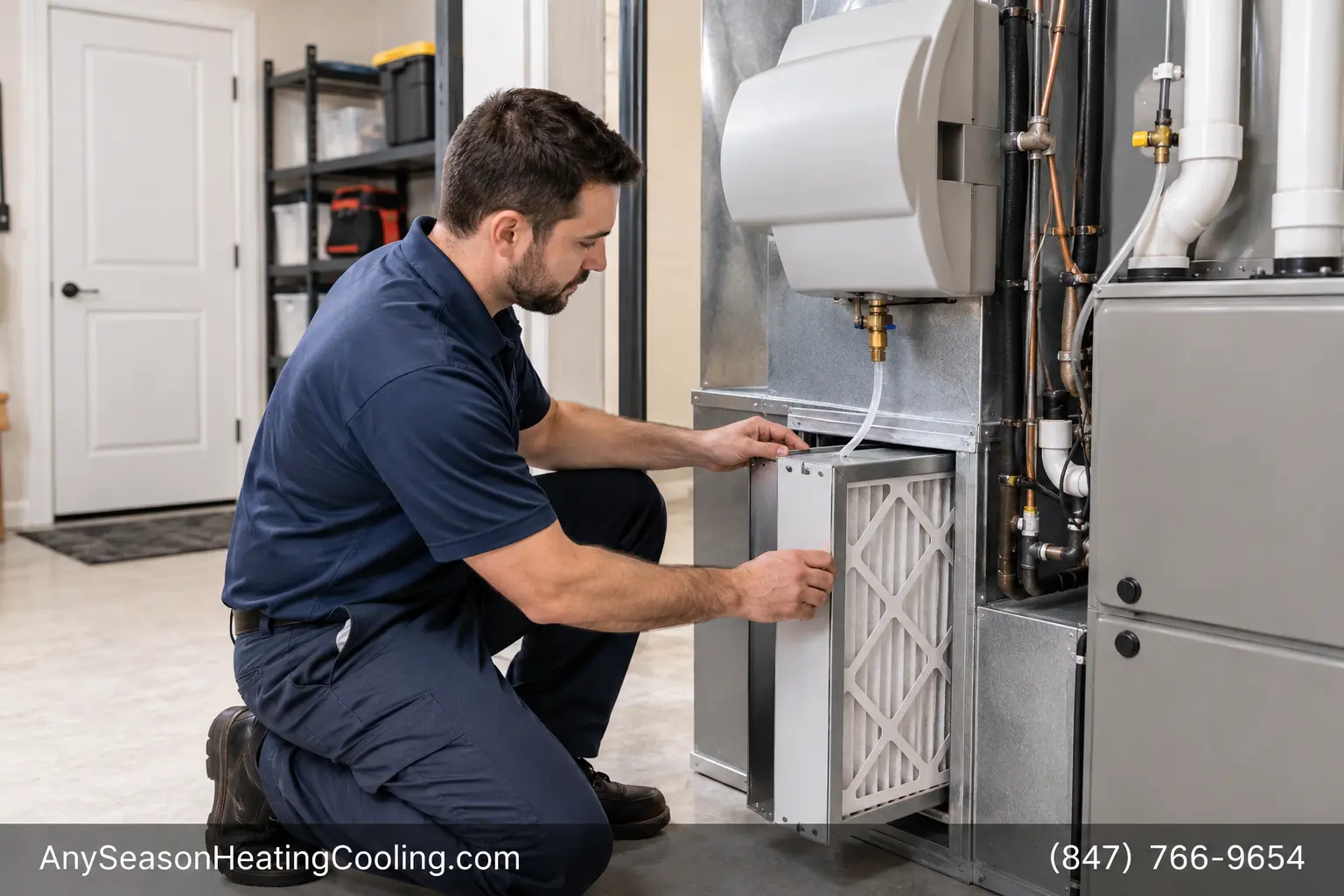
Related Heating, Cooling and Air-Quality Services
Connect With Any Season Heating & Cooling
Learn more about our Des Plaines HVAC company, read verified customer feedback or follow recent company updates.
Talk With a Local HVAC Professional
Describe the heating, cooling or indoor-comfort problem and we will help you determine the appropriate next step.